Adults Deserve a Recital, Too: Making Raleigh’s Stages Feel Welcoming for Late-Start Musicians
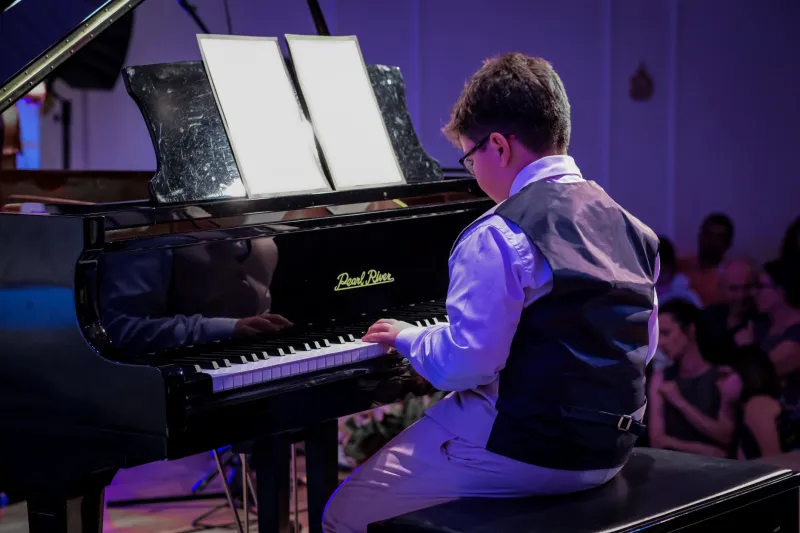
Walk into many music schools on recital day and you’ll see a familiar split: children on stage, adults in the audience holding programs and phones. That’s a shame. Not because kids shouldn’t perform—they should—but because the stage has been quietly coded as a childhood milestone. For adults who started lessons later, the message can feel implicit: practice is fine, performance is for the kids.
We think that’s backwards. Adult learners need a low-stakes stage as much as anyone. They just need one built for adult schedules, adult nerves, and adult definitions of success.
The Stage Is a Feedback Loop, Not a Trophy
Performance isn’t a reward for starting young. It’s a learning tool. When an adult beginner prepares a piece for even six listeners, several useful things happen: practice gets a deadline, mistakes become survivable, and the student gets a reality check that is kinder than the one in their own head.
A lot of adult students practice in private for months or years. They play for a teacher, maybe a spouse, maybe the dog. That’s real progress, but it can stall. A small performance gives the work a shape. It says: this piece is finished enough to share. That’s not about ego. It’s about closure, confidence, and the next round of goals.
The Reasons Adults Avoid Recitals Are Real
Let’s not pretend the hesitation is imaginary. Adult beginners worry about being judged. They worry about sitting next to a seven-year-old who plays circles around them. They worry about busy weeks, shaky hands, and the awkwardness of being the only grown-up on stage.
Those fears are reasonable. But they’re also reasons to change the format, not reasons to skip performance altogether. A traditional recital is one option, not the only one. The goal is a supportive room with a clear invitation and an easy exit ramp.
Formats That Work Better Than a Formal Recital
Living-room showcases. Six to ten friends, two short pieces, snacks afterward. This is the lowest-stakes version, and it counts. A Sunday afternoon in a Five Points living room can be just as legitimate as a formal hall downtown.
Café performances. A fifteen-minute set in a coffee shop or community space gives adult learners an audience without the pressure of a silent concert hall. Background noise can be a feature, not a bug.
Studio recitals with mixed ages or an adults-only slot. A program that includes adult beginners alongside kids can normalize the idea that music study happens at every age. An adults-only showcase can be even more comfortable for first-timers.
Works-in-progress nights. No polished repertoire required. Students play a section, ask for feedback, or try a piece they’re still learning. This format takes the fear of “finished” off the table.
A private recording session. For adults who truly aren’t ready for an audience, recording a piece for family or a teacher can be a bridge. It’s not the same as a live room, but it’s not nothing.
An Eight-Week Prep Plan That Won’t Take Over Your Life
Most adult learners don’t need a months-long recital grind. A realistic eight-week runway is enough for a short piece or two.
Weeks 1–2: Choose repertoire you actually like. Mark the tricky spots and set a tempo that feels steady, not heroic.
Week 3: Practice slowly and record yourself once. Listen for one thing to improve, not ten.
Week 4: Perform for your teacher in a lesson. Treat it like the real thing: start, stop, recover, finish.
Week 5: Play for one trusted person. This is often the hardest step, and it’s worth doing early.
Week 6: Run the full set twice in one sitting. Practice walking to the instrument, settling in, and beginning.
Week 7: Do a dress rehearsal in the shoes and clothes you’ll wear. If possible, play in the actual room or a similar space.
Week 8: Perform. Afterward, write down one thing that felt better than expected. That note becomes evidence for the next time.
If eight weeks feels tight, make it ten. The timeline is a tool, not a test.
How to Make the Room Supportive
The audience matters as much as the performer. Invite people who know how to be a good audience: they applaud, they don’t critique, and they don’t ask why you didn’t start earlier. Have a host or teacher emcee the event and explain the vibe. Keep the program short. Normalize restarts. Skip rankings, prizes for “best beginner,” and any language that turns a sharing moment into a competition.
Why This Belongs in Raleigh’s Music Community
Raleigh is full of adult learners—parents who wait during their kid’s lesson, remote workers who want a creative outlet, retirees returning to an instrument, and career-changers who finally have time. They deserve the same steady progress and stage opportunities we build for children.
A stage doesn’t have to mean a big hall. It can be a living room, a café corner, or a studio recital with folding chairs and a plate of cookies. If you’ve been taking lessons and playing only for yourself, consider this your invitation. The recital doesn’t have to be intimidating. It just has to be small enough to say yes.