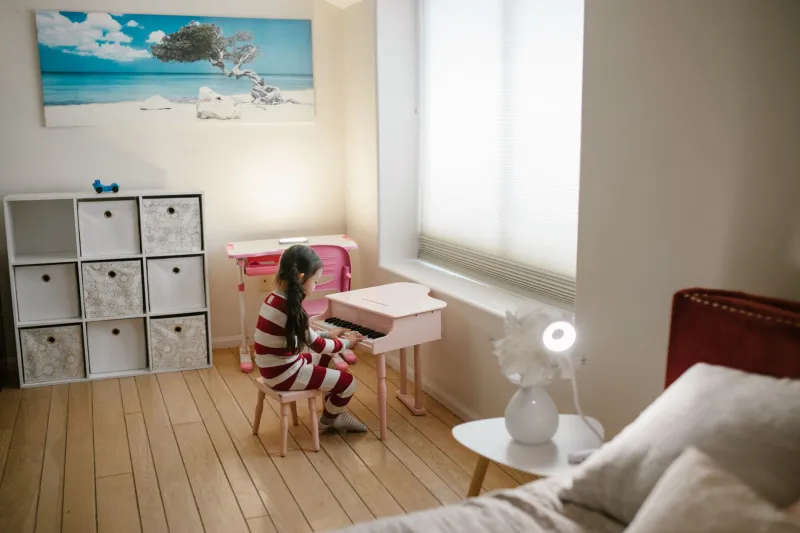
Before the Bow: A Parent's Playbook for Your Child's First Recital

The first recital is a milestone for the student, but it's also a milestone for the parent. You're the one holding the music bag, scanning the room for the sign-in table, and trying to figure out whether your child needs a pep talk or a snack. The good news: you don't need to be a music teacher to be exactly the right kind of support. You just need a plan.
At Raleigh Music Academy, we see first-time recital families every season. The students who walk onstage with steady feet are rarely the ones who practiced the most. They're the ones whose adults kept the week calm, kept the praise specific, and kept the pressure low.
Two weeks out: practice the whole moment, not just the notes
Most students practice the piece. Fewer practice the recital. That's a gap worth closing early.
Two weeks before the performance, ask your child to do a full run-through — walk to a pretend stage, pause, bow, play the piece, bow again, and walk off. They can do this in the living room. The point is to rehearse the sequence, not just the song. If they make a mistake, they keep going. That's the most important skill onstage: recovery, not perfection.
This is also a good week to record one video. Not for critique — for proof. Kids often don't realize how much they've improved until they see it. Watch it together once, name one thing that sounded strong, and leave it alone.
One week out: logistics beat last-minute panic
Recital-week anxiety often has less to do with music and more to do with unknowns. Where do we park? What time do we arrive? Is the music memorized or can they use the folder? Does the piano have a bench that adjusts?
Confirm the details early. Lay out the outfit. Pack the music, the rosin, the capo, the water bottle, or whatever the instrument requires. Label the case. Know the student's name pronunciation if the emcee will announce it. A little boring preparation buys a lot of calm.
Recital week: protect sleep and keep praise specific
This is not the week to add new repertoire or fix a technique issue that has been simmering for months. Keep practice light and familiar. Protect bedtime. Avoid the phrase 'don't mess up' — the brain is terrible at negating instructions, and 'don't mess up' just plants the picture of messing up.
Instead, try: 'I'm proud you're doing this.' 'You've worked hard on this piece.' 'Your job is to play, not to be perfect.' Those sentences give a child something to hold onto that isn't a demand.
Backstage jitters: what actually helps
Nerves are normal. They're also physical. A racing heart and shaky hands are not signs that something is wrong; they're signs that the body is getting ready to do something that matters.
A few backstage tools that work for kids and adults alike:
- Box breathing: inhale for four, hold for four, exhale for four, hold for four. Repeat four times.
- A phrase script: 'I know the first line. I can start there.' Keep it that simple.
- One friendly face: tell the student to find one person in the audience who looks happy to be there.
- Permission to be nervous: 'You can be nervous and still play. Those two things can live in the same body.'
Parents should model calm, not perform it. If you're anxious too, say so lightly: 'I get nervous before things I care about. Let's take a breath together.' That's more useful than pretending you're made of stone.
The practical checklist
- Confirm arrival time, location, and parking.
- Pack music, instrument, accessories, and water.
- Lay out the outfit the night before.
- Do one calm run-through earlier in the week — not the morning of.
- Arrive early enough to find the green room without rushing.
- Keep the pre-show talk short and warm.
- Find a seat near the front but not in the front row if your child prefers a friendly buffer.
- Plan a low-key treat for afterward — ice cream, tacos, a park stop.
- Put the phone away during the performance. Watch with your whole face.
After the applause: what to say and what to skip
What you say in the first two minutes after a recital sticks. Lead with warmth, not analysis. 'You did it.' 'I loved watching you.' 'You looked nervous and you played anyway — that's brave.'
Then ask an open question that isn't about mistakes: 'What felt good up there?' or 'What was the best part of the day?' If your child brings up a wrong note, don't argue with the feeling. Normalize it: 'Everybody has a moment like that. You kept going, and that's the skill.'
Skip the ranking. Skip the comparison to other students. Skip the detailed critique in the parking lot. There's plenty of time for teacher feedback at the next lesson. Recital day is for pride and recovery.
Instructor perspectives: confidence is built, not summoned
Elena Ruiz, a violin instructor at Raleigh Music Academy, says first-recital nerves are rarely about the music itself. 'They're about being seen,' she says. 'The students who grow into confident performers are the ones who learn that being seen is survivable. A parent who stays steady backstage teaches that faster than any speech.'
Marcus Bell, who teaches voice, adds: 'Don't wait for confidence to arrive before the recital. Confidence is the souvenir you pick up after doing the scary thing a few times. The first one is supposed to feel like the first one.'
The takeaway
The first recital doesn't have to be perfect. It has to be survived, celebrated, and repeated. Your job as a parent is not to eliminate nerves or guarantee a flawless performance. It's to be the calm, steady presence in the room — the one who helps your child walk toward the stage, bow, play, and walk back out knowing they did something brave. That's how long-term stage confidence starts.