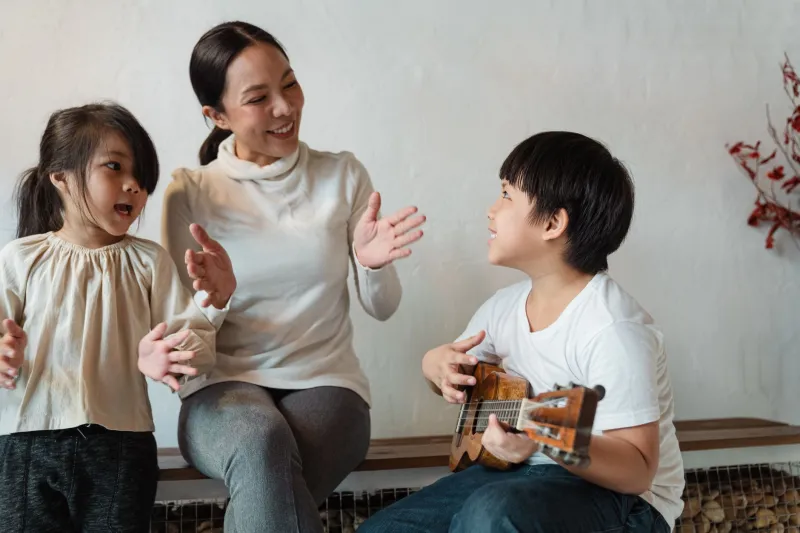
The Off-Key Living Room: A Raleigh Family's Monthly Jam Night Playbook
Photo: U.S. National Archives, Department of Defense. Department of the Army. U.S. Civil Administration of the Ryukyu Islands., Public domain, via Wikimedia Commons
Most families treat music at home like a recital waiting to happen: tidy, quiet, and saved for when someone has practiced enough. A monthly family jam night flips that script. It is not a performance. It is a household habit, twenty-five minutes of imperfect, slightly chaotic music-making that makes lessons feel like part of family life instead of homework.
Why bad and loud is the point
When a student plays alone, every wrong note feels like a verdict. In a family jam, wrong notes are just weather. Someone misses a chord change, the tempo wobbles, the dog joins in. Everyone keeps going. That is the skill teachers quietly cheer for: recover and stay in the music. Shared playing also builds listening. A child has to hear the guitar, the shaker, and their own voice at the same time, then adjust. That is ear training disguised as a Saturday afternoon.
There is a lesson in watching adults be beginners, too. If a parent takes a wobbly turn on the ukulele, the child learns that music is not a talent contest. It is something people do together.
Ground rules that keep it fun
A jam night dies fast if it turns into rehearsal with a judge. Try these house rules:
- Pick two or three songs, not a setlist.
- Set a timer for twenty to thirty minutes.
- Count in together, then keep going. Save corrections for after the song.
- Give everyone a job before the first downbeat.
- Record one take on a phone if you want, but do not review it mid-jam.
- Stop while people are still laughing.
The last rule matters most. A short jam that ends on a high note gets repeated. A long one that ends in tears does not.
Three-chord starters for a Raleigh living room
You do not need a deep catalog. Start with songs that survive on three chords and a steady pulse. Three Little Birds works with A, D, and E. You Are My Sunshine lives in C, F, and G. This Land Is Your Land is friendly in G, C, and D. Bad Moon Rising runs on D, A, and G. If the key is too high for a singer, move the capo or transpose. If a chord is too hard, swap in a simplified version or let one instrument hold a drone.
Raleigh families can also raid the student’s lesson book. A piece from the current method book, slowed down and repeated four times, makes a fine jam vehicle. The point is not the song. The point is the shared pulse.
Jobs for every age and ability
Mixed ages are not a problem if everyone has a role. The youngest player can handle a shaker, a hand drum, or a simple cue card that says start and stop. An elementary student might play one-finger ukulele chords, keyboard root notes, or a recorder line. A teenager can anchor the bass roots, keep time on a cajon, or run the phone recorder. Adults can cover guitar, keys, or vocals, but they should not hog every solo.
The non-player in the room still has work. Make them the conductor, the timer, the page turner, or the snack captain. A conductor who cues entrances is practicing listening just as much as the guitarist. Rotate jobs each month so no one gets stuck behind the same instrument.
For mixed ability levels, choose a common key and simplify without apology. One chord can be enough. A repeated bass note can be enough. A tambourine on beats two and four can be enough. The jam is a low-pressure stage, not an audition.
Small apartments and close neighbors
Volume is a real issue in Raleigh apartments, condos, and older homes with thin walls. You can still jam. Use felt picks, brushes instead of sticks, and a towel in the sound hole of an acoustic guitar. Put a blanket under the drummer. Skip the amp for electric instruments and use headphones with an electronic kit. Keep the low end modest, because bass travels through floors. Schedule the session for a weekend afternoon rather than late evening, and give the downstairs neighbor a heads-up if you are trying a louder month.
If the weather cooperates, a porch or patio session can work. Just watch the humidity and keep instruments out of direct sun. A small room with soft furniture is often better than a big empty one.
The lesson connection
Family jam night does not replace practice. It reinforces it. Students practice counting in, listening across the group, and recovering from mistakes without stopping. Those habits show up in lessons. Teachers at Raleigh Music Academy often hear the difference between a student who only plays alone and one who plays with other people.
Keep the two worlds separate. Practice is for polishing. Jam night is for using music. If a student wants to bring a jam song to their next lesson, great. If not, let it stay a family thing.
A simple monthly routine
Put it on the calendar for the same weekend each month. Make a short setlist and stick it on the fridge. Set up chairs, tune, count in, and play. Record one phone take if the group wants a memory. End with a snack and one sentence from each person about what felt good. No grades, no critiques, no encore unless everyone is still smiling.
Raleigh has plenty of stages for polished performances. The living room is where students learn that music belongs to them. Play badly. Play loudly, within reason. Play often. The lessons will follow.