The Living Room Conservatory: Seven No-Screen Music Games for Raleigh Families
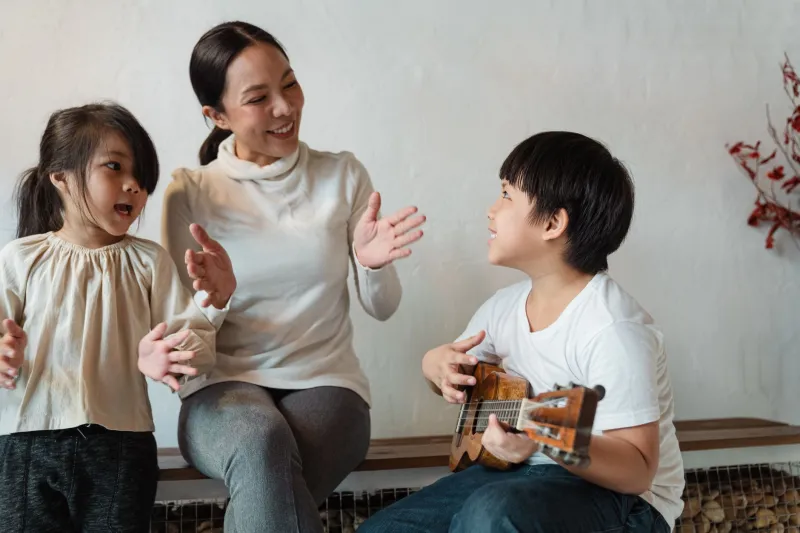
A rainy afternoon in Raleigh has a way of shrinking the house. The practice room gets stale, the couch starts calling, and suddenly every family member is drifting toward a screen. But music practice does not always need a music stand and a metronome. Sometimes it needs a laundry basket, a wooden spoon, and ten minutes of silly focus.
These seven games are designed for exactly that kind of indoor day. They are short, low-prep, and flexible enough for a seven-year-old and a forty-seven-year-old beginner to play together. Each one reinforces a real lesson skill — steady beat, dynamics, ear training, phrasing, pitch matching, tempo, and rhythm — without a worksheet in sight.
Pick one game. Play for five to ten minutes. Stop while it still feels fun. That last part matters more than any perfect clap.
1. The Laundry-Basket Drum Circle
Lesson skill: steady beat
Flip a laundry basket upside down and hand out wooden spoons or soft mallets. Pick a familiar song — something simple like Twinkle, Twinkle, Little Star or a family favorite — and tap the steady beat together. No fancy fills. No speeding up. Just the pulse.
For younger children, let them use a whole hand instead of a spoon. For older kids, alternate hands. Adult beginners can add a gentle foot tap to feel the beat in the body. If someone loses the beat, laugh and restart. The goal is not perfection; it is the feeling of staying together.
2. The Volume Weather Report
Lesson skill: dynamics
One person narrates the weather while everyone else plays or sings along. Fog is very soft. A breeze is soft. Steady rain is medium. A thunderstorm is loud. The narrator can change the forecast without warning, and the family follows.
This is a playful way to practice piano, forte, crescendo, and diminuendo without using the Italian words unless your student wants them. Younger kids love conducting the storm. Adult beginners can practice making a smooth crescendo instead of jumping from soft to loud. Keep the dynamic changes musical, not just noisy.
3. Name That Room Tone
Lesson skill: ear training and listening
Set a timer for thirty seconds and close your eyes. Everyone listens to the room. What do you hear? The refrigerator hum? Rain on the window? A clock? A neighbor's dog?
Go around the circle and imitate one sound with your voice or an instrument. Then compare: was it high or low, long or short, steady or spiky? For a slightly harder round, one person makes a sound and everyone else describes it without naming the object. Adult beginners can practice matching the pitch of a hum or a refrigerator's low drone. Children often notice details adults miss.
4. The Two-Beat Story
Lesson skill: phrasing and form
Each person contributes a two-beat sound or movement to build a tiny story. One person claps twice. The next stomps twice. The next says a two-syllable word like sun-shine or rain-drop. Keep going until the story feels finished.
Then play it again from the beginning. That repetition is the point — it teaches phrase shaping and form without a lecture. Younger children can use animal sounds. Older students can map the story as A-B-A and try to repeat the first section at the end. Adult beginners can practice making each two-beat phrase feel intentional rather than accidental.
5. The Hum-and-Find
Lesson skill: pitch matching and ear training
One person hums a single note. Everyone else slides their voice up or down until they match it. That is the warm-up. Then hide a small object — a stuffed animal, a coaster, a spoon — and have the seeker find it while the group hums louder when they are close and softer when they are far away.
For young children, keep the humming on one comfortable note. For adult beginners, hum a short three-note pattern and have the seeker echo it before moving. This game sneaks in pitch awareness and dynamic control while everyone is busy hunting for a stuffed bear under the coffee table.
6. The Slow-Motion Conductor
Lesson skill: tempo and following a leader
The conductor raises their hands and sets a tempo — slow, medium, or fast — using imaginary instruments or simple claps. The family follows. The conductor can change tempo gradually or surprise everyone with a sudden stop.
Younger kids love the drama of a frozen orchestra. Older students can practice watching a conductor's hands instead of guessing. Adult beginners can take a turn conducting and feel how hard it is to keep a steady tempo when everyone is watching. No screen, no metronome, just eyes and ears.
7. The Echo Bench
Lesson skill: rhythm and memory
Clap a short rhythm and have the family echo it back. Start with two beats. Add one beat each round. Use names or familiar phrases to help — Ma-ry had a lit-tle lamb has a built-in rhythm. If someone misses, the group resets to an easier pattern and tries again.
For children, keep patterns short and playful. For adult beginners, add rests or syncopation. The game builds rhythmic memory and active listening, and it works just as well with hand drums, spoons, or lap taps.
Keeping It Light
These games are not a replacement for lessons. They are a bridge between lessons — a way to keep ears and hands active when the weather keeps everyone inside. If a game clicks, make a note and tell your teacher at the next lesson. A quick mention like we have been playing the volume weather game gives the instructor a useful window into what is sticking at home.
A few ground rules help. Keep sessions short. Choose one skill at a time. Resist the urge to correct every wrong note. And let the adult beginners play, too — not just supervise. In a Raleigh living room on a rainy Saturday, the best music game is the one that gets everyone laughing and listening together.
No screens required. No worksheets. Just a little rhythm, a little patience, and maybe a laundry basket.